Automobile road maps were
preceded by bicycle maps. Back then it was not clear if bicycles
or automobiles would dominate and road improvements were made as
much for bicycles as cars. Prior to 1895, the demand for good
road maps came from bicyclists. From around 1895 to 1905,
automobilists and bicyclists vied for control of the roads, and
from 1905 on the automobile had won out. The first automobile
road map in the United States is generally credited to the
Chicago Times-Herald newspaper, which printed a route map in 1895
for a race they sponsored from Chicago to Waukegan, see Ristow (1946)
or Yagoda.
Larger scale county maps
often included roads, and maps of urban areas were sometimes
called 'driving' maps; it was left unclear whether carriages,
bicycles, trollies, or autos were to be driven. The 19th century
county atlases produced by publishers like Beers, Everts,
Caldwell, etc. included large scale township maps with roads
shown.
 |
1822
MAP OF THE NATIONAL ROAD BETWEEN CUMBERLAND AND WHEELING,
Engraved for J. Melish's Description of the United States
& Travellers Directory. This is one of the earliest
maps of the old National Road across southwestern
Pennsylvania. Many towns are shown, including W.
Alexandria, Washington, Union(town) in heavier type. The
map is printed on very thin paper, originally folded, and
from A Geographical Description of the United States,
with the Contiguous British and Spanish Possessions,
by John Melish, Philadelphia 1822. The first edition
appeared in 1816, but the 1822 edition had 12 regional
maps including this one. The National Road west (originally
called the Cumberland Road) was proposed in an 1806 Act
of Congress. The act was signed by President Jefferson
who appointed the first commissioners. It was planned as
a way to tie the states being created from the old
Northwest Territory, Ohio, Indiana, Illinois, Michigan,
into the east. Construction began on the section west
from Cumberland in 1811. By 1818 coaches were running
between Washington and Wheeling. In 1819 construction
came to a halt due to a financial panic. In 1822 a bill
for repair of the road and authority to collect tolls
passed the Congress, but was vetoed by President Monroe.
He held that Congress did not have the right of
jurisdiction and construction, but Monroe also
recommended a national system of internal improvements. A
number of alternatives were examined for additional 'National
Roads', including a route up the Susquehanna River valley
(see the 1827 map in 19th Century maps). However only the
Old National Road, today's US 40, was constructed by the
Federal government during the 19th century. It was
continued west across Ohio in the late 1820's eventually
reaching Vandalia, then the capital of Illinois. There is
a National Road Museum in Zanesville, Ohio, and many
books have been written about the road. No Longitude,
blank verso. Scale: 1 inch = 10 miles. Size: 6 x 11
inches. |
 |
1826
MAP OF A RECONNAISSANCE BETWEEN BALTIMORE AND
PHILADELPHIA, EXHIBITING THE SEVERAL ROUTES OF THE MAIL
ROAD CONTEMPLATED BY THE RESOLUTION OF CONGRESS APPROVED
ON THE 4th OF MAY 1826. S. Bernard Brigr. Genl. Member of
the Board of Intl. Improt. William Tell Poussin Capt. Top.
Engs. and Assistant to the Board. This long, narrow map
shows roads from Philadelphia west into Delaware and
Maryland. Only
eastern
and
western
sections including
Pennsylvania are shown here; about one third of the map
includes the state. The date given is that of the
resolution and the map was published around the same time, but exactly
when is not known. Blank verso. Scale: 1 inch = 3 miles.
Size: 9 x 31 inches. |
 |
1848
A VIEW OF THE LAW OF ROADS, HIGHWAYS, BRIDGES AND FERRIES IN PENNSYLVANIA. By William Duane, Esq. Philadelphia: James Kay, Jun. & Brother, 183 1/2 Market Street. 1848. This is a 156 page book with excerpts of law on roads; the spine title reads "Duane's Road Law." There are no maps or illustrations, just a discussion of road law for (no doubt disgruntled) travelers. The first two chapters on pages 13, 14-15, and 16-17 are shown here. Size: 8 x 5 inches.
|
 |
1867
BARNES' DRIVING MAP OF PHILADELPHIA AND SURROUNDINGS.
From surveys and records by H. E. B. Taylor. Published by
R. L. Barnes, 27 Sth. 6th. Street Philadelphia 1867.
Printed by F. Bourquin. This is the earliest map seen
labeled as a "driving" map, though only stages
and buggys were driven then (well, and locomotives and
boats). It includes the city, adjacent New Jersey, and
much of Delaware and Montgomery county. This map is quite
detailed, showing hotels, businesses, streets and roads,
and railroads. It is surrounded by scroll work similar to
that on Mitchell or Colton maps from this period. The map
was originally folded and either had a cover or was an
insert into a book. It is printed on thin paper and hard
to handle without tearing, so hardly appropriate for busy
drivers. Blank verso. Scale: 1 inch = 0.75 mile. Size: 28
x 30 inches. |
 |
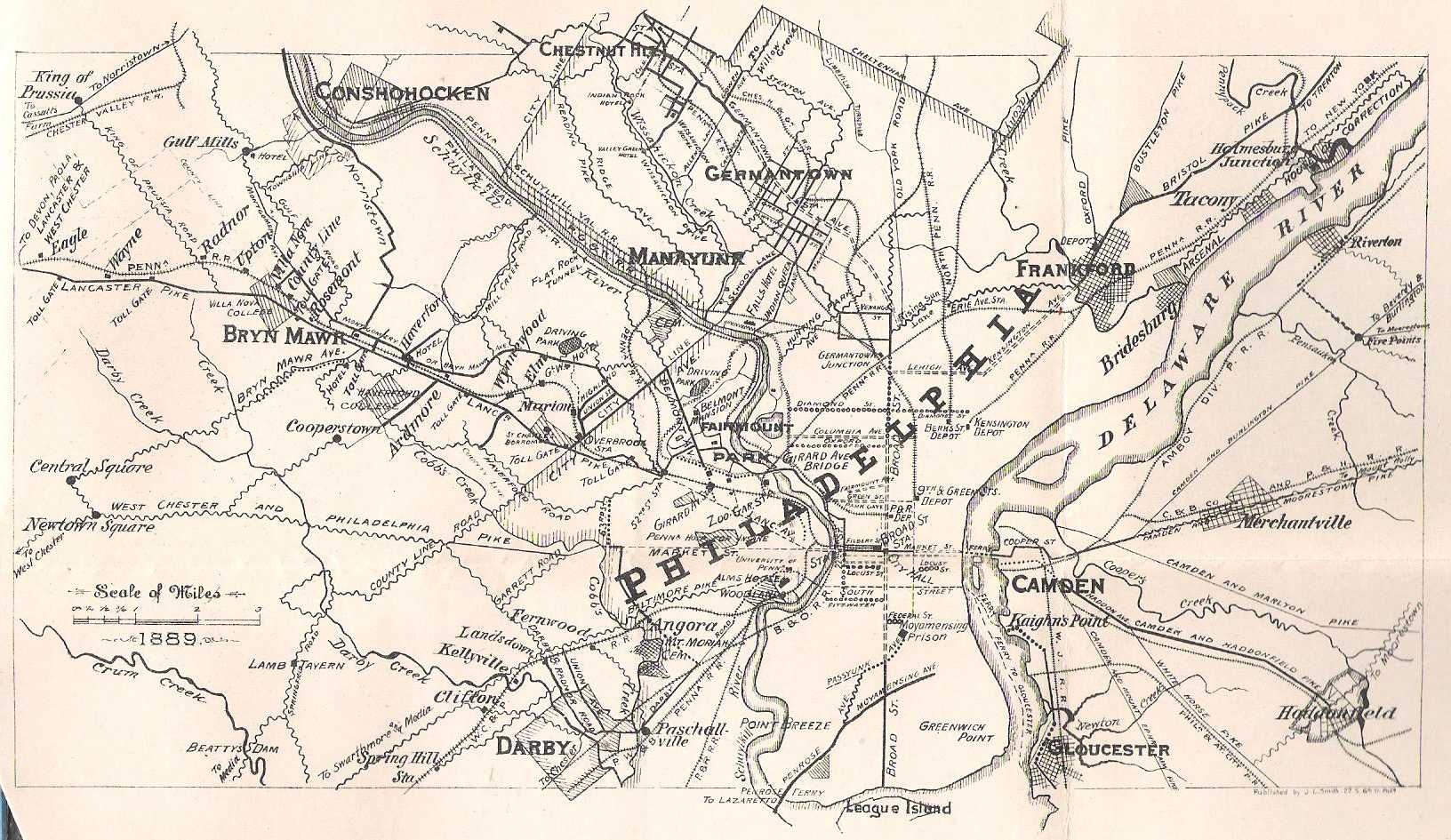
1888
NEW DRIVING MAP OF PHILADELPHIA AND VICINITY, published
by J. L. Smith, 27 South Sixth St., Phila. Pa. This is a
linen backed traveler's pocket map from the pre-automobile
era. It folds into a stiff black 6 x 4 inch cover with
the title SMITH'S MAP OF PHILADELPHIA AND VICINITY. The
map covers Philadelphia and the inner areas of
surrounding counties including New Jersey. Views of the
title area
and
southwest section
of the map are shown here. At
this large scale, turnpikes (i. e. toll roads), local
roads, rail lines, canals and even individual houses are
shown. This is a later version of the R. L. Barnes map
above. Smith worked for Barnes and took over his business
around 1870. Blank verso. Scale: 1" = 1 mile. Size:
26 x 22 inches. |
 |
1889
PA.-MD.-N.J.-DEL. ROAD BOOK. Inside is the title ‘League of American Wheelmen Road Book of Pennsylvania, New Jersey, Maryland, and Delaware, and the principal through routes of New York, Connecticut, Massachusetts, Rhode Island, and Virginia. Fifth Edition 1889. Based on the original edition compiled by Henry S. Wood, and revised and enlarged by the Road Book Committee of the Pennsylvania Division. This is a road map booklet of about 260 numbered pages giving directions for about 250 different routes covering the states named. Information provided includes distance between points, material of road, grade of road and condition at its best, turning directions. There are 8 maps attached to the back: Pennsylvania, Philadelphia, New Jersey, Newark, Maryland, New York City area, Staten Island, Long Island. The maps are about 5 x 8 inches. The cover is a leatherette material. Size: 4 x 6.75 inches. |
 |
1890
MAP OF SUSQUEHANNA TP., page 69 from The Illustrated
Historical Combination Atlas of Cambria County,
Pennsylvania by J. A. Caldwell (LeGear L3016). The
scale on this township map, from one of the last of the
classic county atlases, is about 1 inch = 0.7 mile and
the roads are shown by double lines. These large scale
local maps were prepared mostly from government survey
maps, but also from the personal observations of the
surveyors, salesmen, and sketch artists selling the
county atlas subscriptions. Cherry Tree, shown at upper
left and originally called Canoe Place, was a boundary
point for the Purchase Line of 1768 and there is a large
commemorative monument there near the river. Size: 15 x
12 inches. |
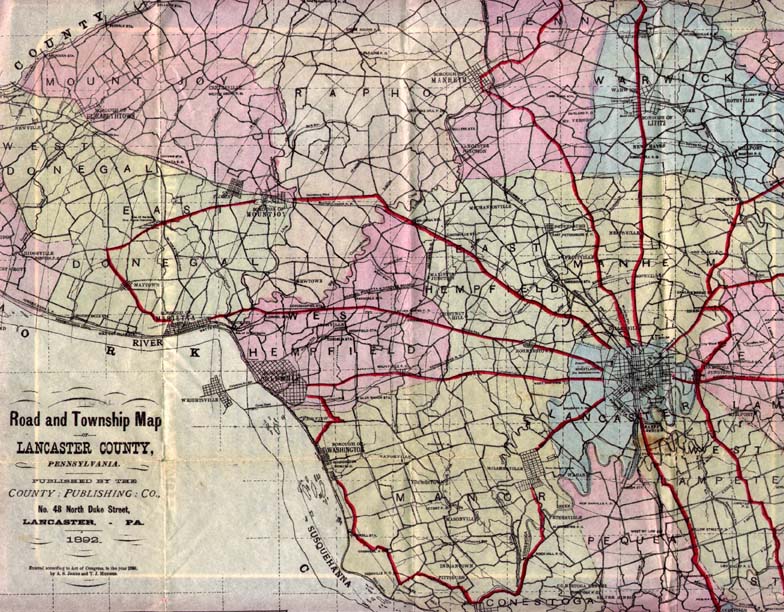 |
1892
ROAD AND TOWNSHIP MAP OF LANCASTER COUNTY, PENNSYLVANIA,
published by The County Publishing Co., North Duke St.,
Lancaster, Pa; entered according to Act of Congress in
the year 1892 by A. S. Johns and T. J. Hughes. Here is an
example of a pre-auto road map in the form of a local
county map. It is inset with an index of towns and looks
similar to a map that might have appeared in a county
atlas. The map folds into an attached gray heavy paper
cover with the title above and below the vendor L. B.
Herr, Books and Stationery, Lancaster, Pa. The main roads
out of town are marked in red. Blank verso. Scale: 1"
= ~1 mile. Size: 20 x 22 inches. |
 |
1893
ROAD BOOK OF THE PENNSYLVANIA DIVISION, L.A.W., Seventh
edition 1893. Based on the original edition compiled by
Henry S. Wood, and revised and enlarged by the Road Book
Committee of the Pennsylvania Division. As shown in this
view inside is the alternative title LEAGUE OF AMERICAN
WHEELMEN ROAD BOOK OF PENNSYLVANIA, NEW JERSEY, MARYLAND,
AND DELAWARE, AND THE PRINCIPAL THROUGH ROUTES OF NEW
YORK, CONNECTICUT, MASSACHUSETTS, RHODE ISLAND, AND
VIRGINIA. Maccalla & Company, Printers, 237-9 Dock
Street, Philadelphia. This booklet resembles the 1889 edition shown above. There are six maps attached
to the back: Philadelphia, Fairmount Park, Pennsylvania,
New Jersey, Maryland, and New York City. The larger maps
are 7 x 12 inches and the smaller half that. |
 |
1895
SECOND ANNUAL ROAD RACE OF THE CANONSBURG CYCLE CLUB, Canonsburg, Pa. Saturday, August 10, 1895. Published by the Canonsburg Cycle Club, W. L. McLoy, Secretary. This is one sheet folded in two and printed on the four sides to make a booklet. One side contains the road map of the race which runs from Canonsburg through Gretna to Washington (Pa.) and back to Canonsburg. All printing is in blue ink. The inside pages include the rules and an entry form. The first prize Rambler Roadster is likely a bicycle and not a car. |
 |
1896
LEAGUE OF AMERICAN WHEELMEN ISSUE OF BEST ROUTES IN AND
AROUND PHILADELPHIA. WITH MAPS AND ILLUSTRATIONS. Written
and illustrated by Frank H. Taylor, 225 South Fifth
Street, Philadelphia. 1896. This is a road map booklet
for the city area. The map is printed on both sides and
is very similar to the map in the 1897 book below, as
shown in this
Map Image
. However, this map is titled
BEST ROUTES CYCLING AND DRIVING MAP OF PHILADELPHIA.
Published by Frank H. Taylor, G.W. Bromley & Co. Lith.
1896. The
verso
shows western Philadelphia
with part of adjacent counties. |
 |
1897
SECTIONAL ROAD MAP PHILADELPHIA TO NEW BRUNSWICK AND PLAINFIELD, N.J. SHOWING THE GOOD ROADS. Published by R.D. Servoss, 9 to 15 Murray St., New York. There are two 9 x 28 inch strip road maps copyright 1897 by Servoss in this folder. One is pasted on the back cover and shows a route to Plainfield through New Jersey. The
other map is pasted on the front cover with the title above. It shows routes from Philadelphia to Trenton running up both sides of the Delaware River. An included sheet contains hand written route notes for a bike ride in 1905. |
 |
1898
PENNSYLVANIA ROAD BOOK -1898 - WESTERN SECTION, compiled
by W. West Randall and Carl Hering of the Road Book
Committee of the Pennsylvania Division, L.A.W. ( i. e.
League of American Wheelmen, a bicycle club). This is an
84 page cloth cover book containing 71 pages of detailed
road maps of Western Pennsylvania, a few pages with tours
you can take (i.e. Waynesboro, Pa. to Natural Bridge, Va.
etc.) and a town index. There is a similar book for the
eastern section of the state, see 1900
in Road Maps. The maps cover the state from Harrisburg
west with a scale of 1" = 5 miles. Stone (called
winter) roads are shown in bold line, dirt (or summer)
roads in lighter line. On the
Map Image
of a northwest part of the
state, the dark lines are 'good summer roads', the dashed
lines 'fair summer roads'; there are no 'winter roads' in
this area. Rail lines are also shown, perhaps so the bike
rider can get back home. Bicycle maps were a forerunner
of automobile maps and were actually better than the
early auto maps because they showed more detail and more
care was taken in their preparation as they were made
specifically for club members. Book size: 7.5 x 4.5
inches. |
 |
1899
CYCLISTS' ROAD MAP OF THE PHILADELPHIA
DISTRICT showing all the roads and points of interest
with the cycling roads distinguished by red lines,
published by Geo. H. Walker & Co., Lithographers, 221
High St. near Rowes Wharf, Boston, Mass. The map shows
all of Philadelphia and the inner parts of surrounding
counties, including New Jersey. The street names and
roads for bicycle riding are marked in red. The image
shows just the western suburbs of Philly and the paper
cover the map folds into. Scale: 1 inch = 1.25 miles.
Size: 26.5 x 32 inches. |
 This
page includes a selection of 19th century maps that show roads.
The government prepared geological and topographical survey maps
starting in the 19th century and many included roads. By 1900
detailed survey maps were available for most northeastern states,
and were used by commercial vendors as the basis for their own
maps. However, systematic mapping of Pennsylvania roads and the
installation of route signs by the government did not occur until
the auto arrived.
This
page includes a selection of 19th century maps that show roads.
The government prepared geological and topographical survey maps
starting in the 19th century and many included roads. By 1900
detailed survey maps were available for most northeastern states,
and were used by commercial vendors as the basis for their own
maps. However, systematic mapping of Pennsylvania roads and the
installation of route signs by the government did not occur until
the auto arrived.